UNIST site map
- Admissions
-
Academics
- Colleges and Schools
-
Academic Affairs
- Academic Calendar
- Academic Curriculum
- Requirements for Graduation
- Browse Open Courses
- Undergraduate Administration
-
Graduate Academic Affairs
- Tuition Fee Payment
- Academic Leave of Absence/ Academic Return
- Voluntary Withdrawal/ Expulsion
- Change of Major
- Change of Degree Program/ Dropping of Degree Program
- Class Period/ Attendance Period/ Academic Year・Semester
- Course Registration
- Course Drop
- Attendance/ Grade/ Exam
- Credit Transfer/ Credit Carryover
- Academic Forms
- Education Support
-
Research/Industry
- Research Aims
- Research Findings
- Researcher Search
-
Research Organizations
- UNIST Multi-Interdisciplinary Institute
- IBS Research Groups
-
UNIST Labs
- Department of Mechanical Engineering
- School of Energy and Chemical Engineering
- Department of Civil
- Department of Materials Science and Engineering
- Department of Nuclear Engineering
- Department of Industrial Engineering
- Department of Design
- Department of Biomedical Engineering
- Department of Biological Sciences
- Department of Electrical Engineering
- Department of Computer Science and Engineering
- Department of Mathematical Sciences
- Department of Chemistry
- Department of Physics
- School of Business Administration
- Graduate School of Carbon Neutrality
- Graduate School of Artificial Intelligence
- Research Support
- University-Industry Relations
- Campus Life
- News Center
- About UNIST
-
etc
- UNIST Bulletin
- Work-Life Balance Support System
- UNIST Gender Equality Plan
- Faculty Invitation for Tenure Track
- Faculty Invitation for Non-Tenure Track
- Board Meeting Minutes
- University Council Meeting Minutes
- Administrative Service Charter
- Privacy Policy
- Copyright Policy
- Rejection of Unauthorized Email Collection
- Operation and Management Policy for Video Information Processing Devices
- Information Disclosure


Connection Points of Knowledge, Everything About UNIST
Try searching.
Recommended search terms


- portal
- U Academics Innovation Center
- Leadership Center
- Dormitory
- Academic Information Center
- International Students Support
- Browse Open Courses
- Course Registration
- Graduation Requirements for Graduation
- Academic Leave of Absence/ Academic Return
- Military Service
- Certificate Issuance
- Academic Calendar
- Scholarships
- Campus Map
- Campus Life Guidebook
- Health Care Center
- Human Rights Center
- portal
- Job Opening
- Announcement for Bid
- UNIST AI Services
- UNIST Daycare Center
- Sports Center
- UI Downloads
- Announcement
- Recruitment of Professors (Non-tenure)
- Faculty Invitation for Tenure Track
- UNIST Academic Information Center
- Office of Research Facilities and Training
- Office of Research Affairs
- Rule Management System
- Academic Calendar


This is a collection of menus necessary for UNIST students .
students
- portal
- U Academics Innovation Center
- Leadership Center
- Dormitory
- Academic Information Center
- International Students Support
- Browse Open Courses
- Course Registration
- Graduation Requirements for Graduation
- Academic Leave of Absence/ Academic Return
- Military Service
- Certificate Issuance
- Academic Calendar
- Scholarships
- Campus Map
- Campus Life Guidebook
- Health Care Center
- Human Rights Center


This is a collection of menus necessary for prospective UNIST Students .
prospective Students


This is a collection of menus necessary for UNIST Faculty & Staff .
Faculty & Staff
- portal
- Job Opening
- Announcement for Bid
- UNIST AI Services
- UNIST Daycare Center
- Sports Center
- UI Downloads
- Announcement
- Recruitment of Professors (Non-tenure)
- Faculty Invitation for Tenure Track
- UNIST Academic Information Center
- Office of Research Facilities and Training
- Office of Research Affairs
- Rule Management System
- Academic Calendar


NEWS CENTER
Discover not only Research Findings and event news, but also the diverse facets of UNIST presented by reporters and writers.
News Center

UNIST News
Novel Blood-Based Graft Enables Simultaneous Muscle and Blood Vessel Regeneration
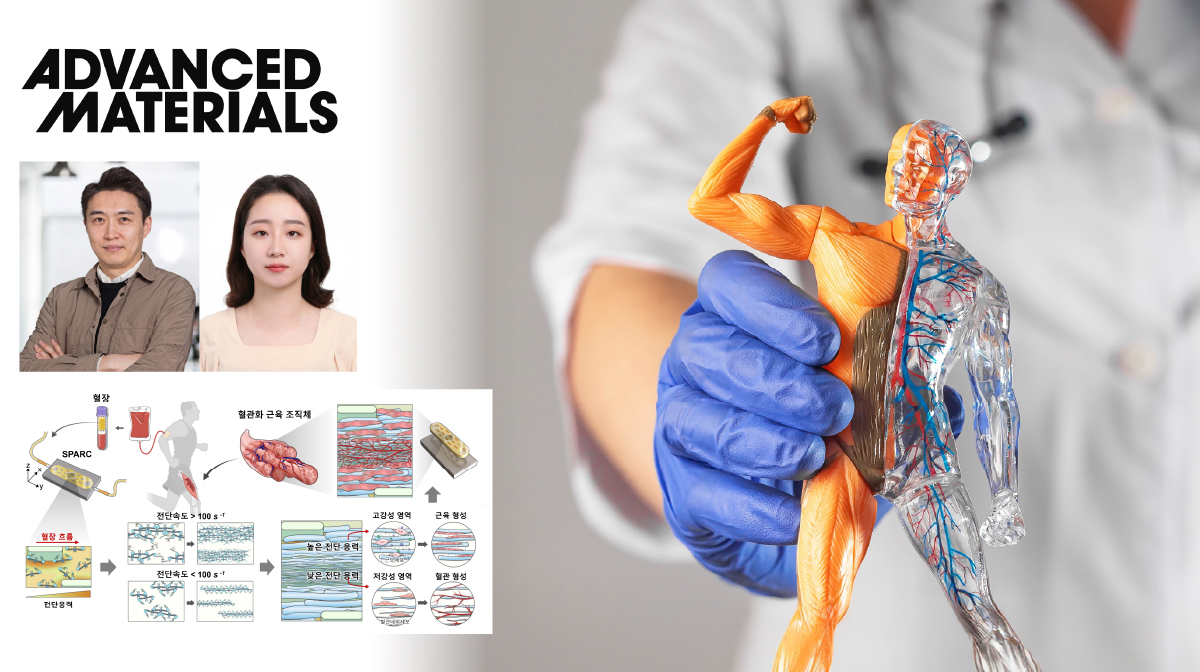
Published in April 2026 issue of Advanced Materials, this breakthrough platform uses patient’s own blood to treat severe muscle injuries.
- Research
- JooHyeon Heo
- 2026.05.28
- 139
Abstract
A research team, affiliated with UNIST has reported a new tissue engineering approach that regenerates muscle and blood vessels at the same time, using only the patient's blood. This technology offers a promising solution for treating extensive muscle loss caused by trauma or surgery.
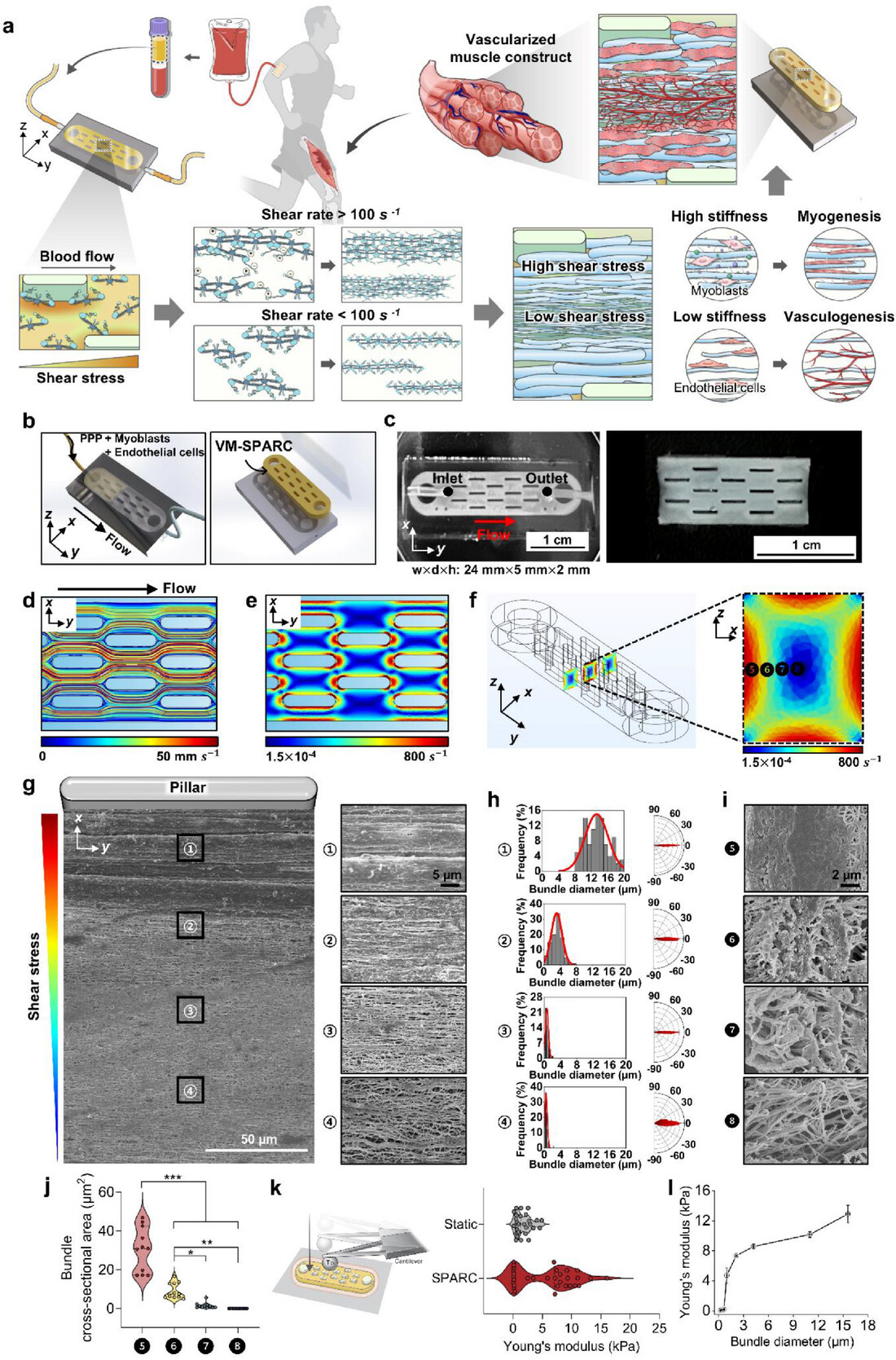
Led by Professor Joo H. Kang of the Department of Biomedical Engineering at UNIST, the team collaborated with Professor Yoonhee Jin from Yonsei University to create a platform called SPARC (spatio-chimeric, plasma-based, shear-responsive construct). Using microfluidics, they assemble fibrin—an essential protein involved in blood clotting—into a structured scaffold. By applying controlled shear stress within tiny channels, they align fibrin fibers in specific patterns. Dense, stiff regions support muscle cell growth, while softer areas promote blood vessel formation. The result is a single, integrated scaffold that guides both tissues to develop side by side.
In tests on mice with large muscle wounds, the grafts successfully connected with the host's blood supply, encouraging the formation of new vasculature and muscle tissue. The animals regained strength and mobility, demonstrating the therapy's potential to restore function.
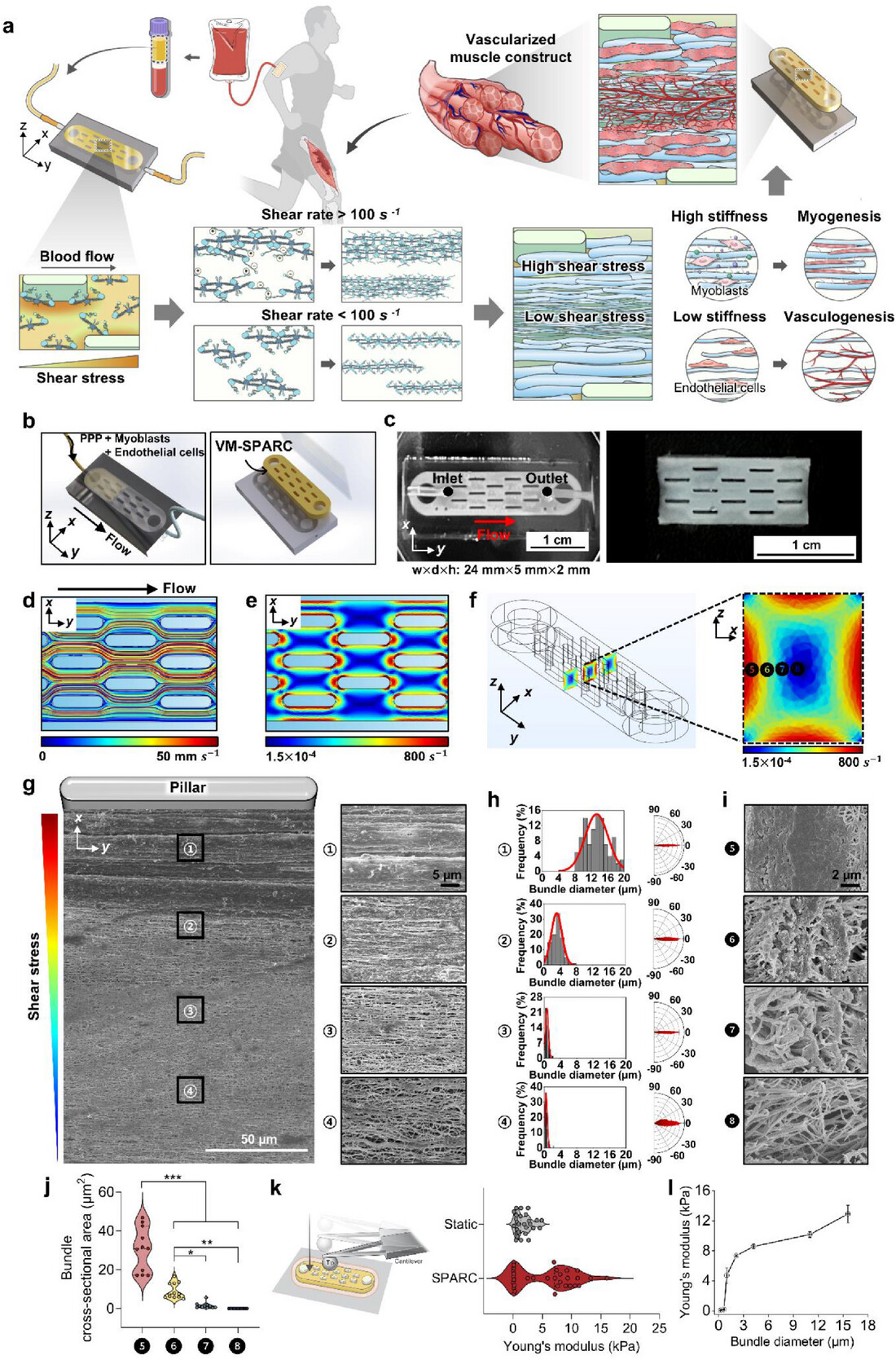
This approach is notable because it uses fibrin derived solely from the patient's blood, reducing the risk of immune rejection. It also simplifies scaffold fabrication by leveraging physical forces to create distinct microenvironments within one material.
“We harness fibrin's natural ability to organize under mechanical shear, creating a multifunctional scaffold from a single, biocompatible material,” said Professor Kang. “This technology could revolutionize treatments for severe muscle injuries and tissue defects.”
The findings of this research were published in the online edition of Advanced Materials on April 22, 2026. The study was supported by the Ministry of Science and ICT (MSIT) and the National Research Foundation of Korea (NRF).
Journal Reference
Su Hyun Jung, Minjun Kim, Da-Yoon Kim, et al., “Mechanically Spatio-Chimeric Fibrin Assembly Enables Vascular-Integrated Muscle Reconstruction for Volumetric Muscle Loss Repair,” Adv. Mater., (2026).
Related Links
Related Photo